Though slightly disappointed in our hotel at Slatinice, we didn’t let that deter us from enjoying ourselves. First would be the ecclesiastical metropolis of Moravia, Olomouc, which can claim the best Communist astronomical clock in the world. Come for the clock, but stay for the Torture restaurant!
Olomouc – where did all the Germans go?
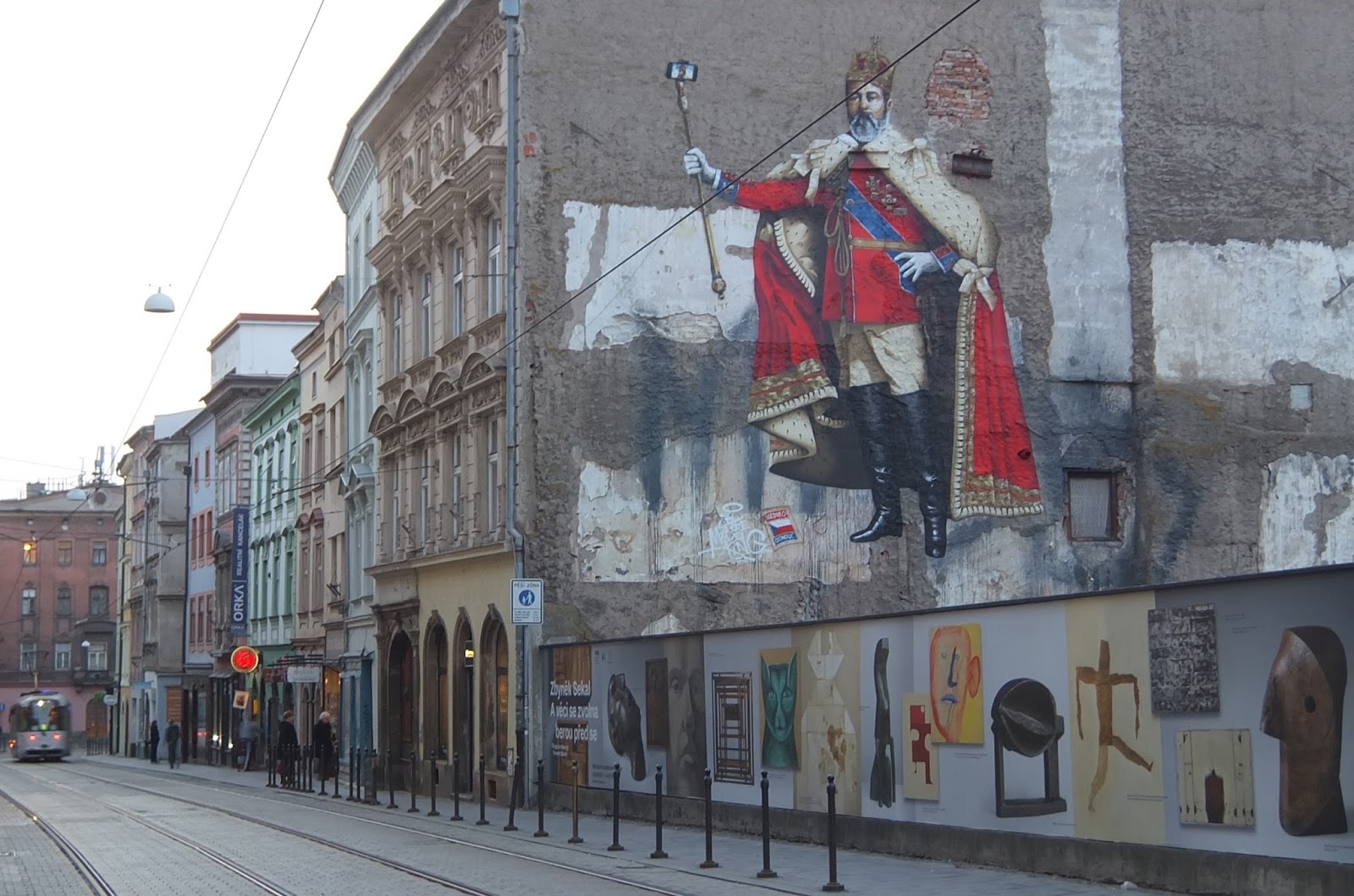
The King takes a selfie
Olomouc has been around since Roman times, serving as a forward operating base against the German barbarians in the 2nd century. It was originally called Iuliomontus (or Mt. Julius), and eventually became a Slavic settlement in the 6th century and in the 9th century became a part of Great Moravia and became its religious center and capital, until the start of the next millennium when Brno stole the mantle of capital. It remained a religious center though, and as such, had very close ties to Germany and developed quite a large German population. During WWII, the city was strongly allied to Germany and somewhat proud of its occupiers, even renaming the town square in honor of Hitler. After WWII, the German population mysteriously vanished, the town declined and eventually turned into some sort of medieval college town, not unlike Krakow’s fate, just north of the Polish border.
One of the biggest clues to its fate was the odd atmosphere that we felt as we walked around. Despite the happening Easter market with the bizarre, Communist-sounding people’s choirs, the town was otherwise empty. Regular restaurants throughout the old town were fairly sparse, however the bars and kebab and pizza shops were plentiful. In all, it told me that story of endless fun during the school year nights.
A castle, or something like it
St. Maurice's
Olomouc’s castle is very similar to Prague’s in that you wouldn’t have realized you were in a castle until someone told you that you were. There are no walls, just a big square, a big church, and old palaces everywhere. The city itself was walled with a wet moat, though much of that has since disappeared. But doesn’t that deter you from going for a medieval experience. Some of the city walls still exist – and some even house dance clubs and coffee shops – and the entire place is something of a cobbled wonderland of churches and Baroque architecture. The two highlights of our short tour was the 15th century Church of St. Maurice, with its tower that’s crowned with battlements. I can’t find anything on why that style was chosen, though I do know off-hand that many Crusader orders decorated their churches back in Europe like this. Whether St. Maurice had any connection to the Templars or Hospitaliers though, I can’t say. Maybe the style was chosen as a dedication to their soldier saint patron.
St. Maurice was originally born in Thebes, Egypt and became a Roman commander of the Theban Legion under the Emperor Maximian in the 3rd century serving in modern day Switzerland. As the Theban Legion was entirely composed of Christians, Maximian wanted to mess with them and issued the order that all soldiers must make sacrifices to pagan gods, but Maurice and his legion inexplicably refused. Maximian then ordered every 10 soldier to be killed, thinking that this would set his legion on the right and honorable path, but they still refused. So then, in one of the more extravagantly wasteful uses of soldierly ever in the history of the world, he had them all summarily killed and they legion of 6,600 soldiers set off to meet their Lord on that day without resistance.
Not your bourgeois movement
Stalin's favorite timekeeper
The next point of interest is the astronomical clock, which far outdoes the one in Prague for being awesome, decorative, and something that must have been in one of Vladimir Lenin’s wet dreams. People flock to the Orloj in Prague to see the giant medieval cuckoo clock where they can ooo and aahh and the saints passing by the windows and the skeleton marketing the time with a bell. But the real clock that people are missing is part of a giant socialist realist mosaic on the northeastern wall of the Town Hall. The clock used to be as cliché as the Prague one, but in 1945, as the Nazis were withdrawing, they did the Czechs one last favor and shot up the tower. After which, the clock was repaired and the little saints were replaced by hard working proletarians, with big hammers and scythes, and motions to depict the hard work of your everyday socialist (not those loafer versions you here Bernie talking about, real Socialists have to work for their free education!).
The clock has a seven-minute long chime and completely non-bourgeois dance and motion, and even marks the birthdays of Stalin and Lenin, and it also lets people know when it’s Labor Day. It also marks every saint day of the year, showing whose day it is on the green dial, with red markings whenever it’s a special Commie day and all the workers have to show up for some parade to show their solidarity.
Orthodox Torture
The Church at the end of the road
Another church of note in town is the pink and green, gold onion domed Orthodox Church of St. Gorazd, built in 1939, which crowns the road going to the East. St. Gorazd was born in Moravia and was originally a Catholic priest with an unhealthy interest in Saints Cyril and Methodius. During the time of the Czechoslovak First Republic, the Czechs and Slovaks were allowed complete spiritual freedom, and so many people left the Catholic Church to try and experiment with other ways of life, things previously outlawed like homosexuality, nationalism, and Orthodoxy. St. Gorazd then converted to the Serbian Orthodox Church and founded a new Czech branch, though when the Nazis came and occupied Czechoslovakia, the church administration shifted to Berlin. St. Gorazd was made famous when after the assassination of the Hangman of Prague, Reinhardt Heydrich, he helped the assassins make their getaway by hiding them in his cathedral. He was found out though and executed.
Inside the Torture Restaurant
Conspicuously on your way to the Orthodox Church of St. Gorazd, you pass by the Torture Restaurant. This was one of the only places we could find to eat that was open, so obviously seeing the title this was our choice. We descended down the wooden stairs – the rails were giant iron chains and the lights were glowing shrunken heads – and found ourselves in a huge dungeon. The bar was made of carved skeletons and dead bodies, and the decorations about the restaurant were of life-sized wood carvings of people getting tortured. Someone getting quartered there, on the rack over there, and before us a naked woman with her hands tied above her head, with only your imagination left to think of ways for her to get it. A classy joint indeed, my friends. The food wasn’t all that bad too, though the goulash was a touch fatty, the sauce did have a nice bit of spice. I’ve an Orthodox friend looking to get married in an Orthodox Church in Europe. It seems like St. Gorazd could have the ceremony and this restaurant would be the perfect reception.
My first visit to Cesky Krumlov was a romantic overnight stay last winter - and I've been back three times. Overnight with a lover is really the best way to see the beautiful crown jewel of South Bohemia. Cesky Krumlov is settled on the tight bends of the Vltava River with several scenic bridges spanning over the sanguine stream, and two large hills littered with cottages and Baroque blocks and one precipitous climb with a castle grasping on the ledges of granite. In the winter, when we were first there, the nights are quiet and the lights dot the darkness like candle flames, the reflection of the water flickering as the gentle wind blows. In the summer, during the days the streets are packed with tourists and the river crowded with kayakers, making their journey through the castle riddled hills of the Czech Republic.
The night lights
The town and castle were founded in 1240 by the Vitkovci clan to protect an important trade route on the southern road leading from Prague to the Alps. The town was built in two stages. When the castle was built, the town Latran was built underneath it, mainly for the administrative staff and servants of the castle. As it expanded, it grew across the river to a “green meadow”, where no previous settlement had been. In fact, that expansion and term led to the name of Krumlov, which itself comes from the German for “crooked meadow”, or Krumme Aue – to Krumlau to Krumlov, "crooked" because of the river.
One branch of the Vitkovci, the House of Rosenberg, came to prominence and took over the castle. The Rosenbergs have a weird family history for Slavs, though it followed the fashion of the time. Many of the old Greek families traced their origins back to the gods, the Roman families often linked their families to the Greeks of myths (or the gods), and the medieval nobility linked their own to the Romans. The Rosenbergs linked their family to the Ursini family, who were said to have resided on Mons Rosarum (hence, Rosenberg). Ursa itself means bear, which led to the family deciding to take on the care of some friendly bears in their moat, a tradition that continues even today.
The crooked meadow
The House of Rosenberg came into decline, especially after several pricey renovations of their castles. Finally, in 1601, Peter Wok von Rosnberg had to settle his debts and sell the castle to Emperor Rudolf II Habsburg. Several wars and a Swedish occupation later, a future Emperor handed the property over to the Eggenberg family. The Eggenbergs died out and the property went where all properties in Bohemia eventually went, to the Schwarzenbergs.
Though Cesky Krumlov can be reached in 3 hours by a Student Agency bus and can be handled within a day, I’d recommend staying the night. Take some time to meander through the cobblestone alleys and streets, have some shisha in the Moroccan flavored Dobra Cajovna, and in general just enjoy the medieval beauty and atmosphere of the old town. Most of the restaurants there are delicious too – there’s always some fresh game at Rozmberska basta, while Kolectiv serves up a fine enough breakfast. For beer, there’s the local Eggenberg brewery which has been supplying the town with brews for the past 500 years.
A Paval work
There are three main attractions in the city. For those of you liking castle tours, the Cesky Krumlov castle is one of the best (the best in the area is in Hluboka, if you can, go there for the tour). Even better though is what’s literally underneath the castle. Within the old wine and storage cellars (and perhaps dungeons?), there is now housed a museum of statues by the Czech artist Miroslav Paval. His work looks like Rodin slipped on a Freudian banana peel and came out with a sexualized statue representation of Dali’s paintings. Which is to say, in a word, awesome. Though most plaques accompanying the scuptures of perverse, mutated figures with seemingly anal fixations have right out political descriptions, one takes notice that there must be something else going on inside of Paval’s mind. However, I still like what he has to say, such as on his statue “Guardian of the Intestines”:
“Up to that point, they were used to living in socialism, ie to go once per year to the Baltics for holidays, to have free weekends, to work only eight hours per day. After the change of regime they suddenly found out they had not enough free time. Successful entrepreneurs stared spending most of their time with their good-looking secretaries and soon after divorced their wives. They used unfair business practices as part of their strategies to be successful. What started to appear in society can be called a new form of aggression – my territory, my carrion, my intestines.”
Lastly not to be missed is the Egon Schiele museum. Mostly the museum has local and national modern Czech artists. But as you get lost in the bizarre layout of the winding corridors, you find a large collection of Ex Libris plates, chocked full of art nouveau occult symbols, and then up finally to the namestake of the house: Egon Schiele’s rooms. There are mostly copies of his work with a few originals, and some of his clothes, along with texts about his life. Schiele was a protégé of Gustav Klimt and spent much of his life in Cesky Krumlov, where his grandmother was from. Most of his art looks starved and deranged and features an almost melting quality, as if the skin and the souls of his subjects were under and intense and putrefying heat. His best works are his nudes, which look like vapid connections to their representations, with hollowed husks of hips and emptied, sagging breasts.
If you only have a day to hit Cesky Krumlov, then do it. But try at most to spend the night and see everything the town has to offer. There’s plenty to do there and around.
It was the best of times, it was the worst of times, it was the age of industry, it was the age of waste, it was the age of wealth unheard of, it was the age of the basest poverty, it was the age of really amazing strudel, and it was the age of abominatory things made from apple. I have tasted the delicacy that is strudel across many a land - and by delicacy I mean some sugary apple slop plopped between two sheets of dough and baked on high. Really, not an overly delicate thing, kind of hard to mess up. Strudel was always a basic desert for me, nothing to get a craving for, until venturing into Kavarna Adria on Jungmannova Street. And then I realized what truly I had been missing, what the ideal of strudel and its heretofore introduction of the reality meeting said ideal. Upon walking into Kavarna Adria, I had left the cave of what I had known to be strudel, and emerged a changed man, a strudeled man.
The outside of Palace Adria
Like most cafes in Prague, Kavarna Adria has nothing to brag for in regards to service. Not kind and not rude, the service is simply there - the exact ideal of service in 19th century Europe, none of that fake American smiling coming from employees making below minimum wage working 12 hour shifts. The service at Adria though is actually a lot better than many Prague spots. The interior is in the what I call First Republic style - which is to say looking like your Viennese cafe of the late Austro-Hungarian Empire, the kind of place that Kafka or Freud would have sipped on coffee and ate their strudels. It was artsy for the time in the art nouveau that was all the rage back then - Kavarna Adria specifically was a really edgy Cubist joint, everything quite square and pointy, with dim, covered electric lights casting a pale pall across everything. The outside looked like an Italian castle was processed through Google's dreamscape set on floral, with small floral details where there shouldn't have been. Situated three flights up, the balcony was high above Jungmannova, with a great view of the surrounding buildings whose styles straddled time like the foundations straddled the square below.
It was there that the Mrs. and I first had our first Praguer strudels, in the dark winter of 2015. Perhaps in February, but it was definitely wintry weather, which means it was the perfect setting for a steaming strudel. It was brought before me on the platter, giant in size, fresh, the apples melting almost into the sauce, mixed in with walnuts, with cinnamon and nutmeg generously sprinkled over. On the side were three great dollops of cream and some home made ice cream. After my first bite, I finally could understand scene from Inglorious Basterds, where Hans Landa nearly has an orgasm over the strudel, and some strange and powerful tension built either over the strudel or the murder of Shoshanna's family, it's quite hard to tell. Here's the scene if you want to know what I mean (fast forward to 2:00):
Understanding that the Adria strudel was the very Platonic ideal of strudel, it became my new fascination in restaurants in Prague. Was this a common achievement that was before me, or was it a rarity? Authentic strudels - that is, those made in Germany or Austria - simply paled to it. I went to many restaurants afterwards and tried many strudels, many were absolutely delicious, yet they were still just shapes brought before the flames, just shadows on the wall. Until finally I went to Cafe Imperial, where I realized the truth about the great diversity of strudels.
I had passed by Cafe Imperial many times, each time peering in with peaking curiosity. It was another First Republic cafe, this one situated near Palladium in the heart of the wealthy locals district of the Old Town - by locals I mean rich expats, by which I mean mostly Russians. The original structure had been erected in 1914 as a last ode and testament of the collapsing Austrian Empire. It was recently renovated, setting it up as a top class destination restaurant. Indeed, the magnificence of the interior itself makes for a worthy visit.The interior breathed art deco. It was as though Dionysius created the place for to be his own dining room. Inside were huge white marble columns, carved from top to bottom with Greek mythological scenes. The back wall was also a giant white carving, a relief of perhaps two maenads holding a covered platter of the remains of a cowardly Orpheus after his vengeful murder at the hands of nude, lustful women. In this setting of the dictionary definition of decadence, and also with a glance at the prices, I thought I was assured to have a divine experience, expecting the pastry to have been made by the dying god's own thyrsus. If only the experience didn't stop there.
The waiter quickly guided us to a seat near the kitchen. It wasn't the best of tables, but as we weren't dressed in fine dining clothes, I didn't really mind. We spoke in Czech, but as we sat the waiter snatched the Czech menus from our hand and replaced them with English ones, along with the word, "English" spoken in a slightly threatening, slightly disgusted tone. But we already knew what we wanted. We were there for coffee and strudel, which we thought was a pretty standard thing at a place that advertises on its website that "coffee and pastry are always important in a Cafe of such style."
What followed next is what I understand how many religious conservatives see homosexuals as. What was placed before us was a real "abomination of the Lord", in such a way that no man could ever manage while lying beside another man. My soul was awash in shame and disappointment over such a cold, dead pomaceous atrocity that lay on the plate before me. It seemed as though they had cooked the thing last week and it had just sat there and possibly fermented during the delay, holding its own bacchanale of yeast and microbes. We had even watched the waiter gather our order together only a few feet away, in full view, with us whispering that it couldn't be our strudel, not so fast, not even heated up, nope it was our strudel. With those two clanks of plate that echoed off our fine oak table, served as though at a nameless Czech restaurant in the darkest dives of Sporilov named U Haseka or U Debilu or something such as.
I thought, maybe cold strudel was their specialty. Maybe it was part of the atmosphere. Back in 1914, it wasn't really possible either to just put something in a microwave behind a wall and heat it up a little, tricking the clientele into thinking it's fresh. That's all I had really wanted was a little bit of trickery. But maybe, just maybe, it was delicious cold.
Containing my disappointment
I had a bite. It tasted as it looked. Stale, slightly fermented, perhaps with a touch of mold. I would have demanded something else, but for the way the waiter had shamelessly prepared it and put it on our tables. The Mrs. said, "Complain!" but I said, "To what use? If he's not even going to heat it up, and he's going to do it all in front of us, I don't think it will do much good. It's sad though, this interior had really got me excited as though I found a new spot. Even if we requested cream, I doubt we'd want to know where it came from!"
But as is the story with most Prague places, the more wonderful it looks, the more terrible it is in reality. The plain, Cubist Kavarna Adria will always hold the place of fine strudeling in my heart.
Over the past few years, Krymska has sprung from being on the border of Prague civilization, from being a hipster central, from being on the border of everything, from being hipster central, and so on. These days, it's back to being the center of it's own little mustachioed polka-dotted world, just after suffering a five year lull which caused the famous Shakespeare and Sons bookstore to close up shop (a decision they're probably regretting now). There really isn't much there for eating, shopping or other non-beverage activities, but the place is beginning to blossom - though from how most people talk, it has already blossomed and the underground appeal has gone on over to the Letna district.
Krymska is in an almost ideal spot for a cool underground neighborhood. It lies in the middle of the Vinohrady district, which itself is on the graveyard of a medieval winery, where as late as the mid-1800s the land was all covered with grapes. The grapes have since been cut everywhere except in the nearby Grebovka Park - aka Havlickovy Park - and have been replaced with most neo-Renaissance, art nouveau and modernist structures jammed together as close as possible. During the Communist years, it was known as a bourgeois, anti-Red hangout area, which is slightly ironic since now it's a bit of an anti-Capitalist area.
Grebovka Park (Havlickovy Park)
The Krymska district can basically be defined as the area around the tram stop of that name, down Francouska to the Ruska tram stop, then diagonally over to Grebovka Park, up to Donska and back up to the Krymska tram stop. Since it's on the face of a steep hill, it has some excellent views down Donska and Krymska, and within its not broad streets with no parking, there are some 20 bars. Not all the bars have markings on their doors, and some resemble more of a hippy's failed state of a living room, but they are there. Three of those bars are live music venues featuring mostly local acts, two are culturally interesting First Republic type places, there's an art house movie theater bar, a couple places are pseudo-dance clubs, and one bar doubles over as a vegan restaurant with great beer. So as you can see, there's no shortage of a good time revolving around fierce amounts of beer.
The Czech Inn at Krymska
Krymska is an especially great district if you're looking to avoid tourist trap bars, as the beer here rarely exceeds two euros and each place is a bit unique and none of them very clean, as they're all quite dive bar type places, though lacking the foosball and beer pong tables that typical American dive bars would have. At the top of the area is the Czech Inn (+420 267 267 612) hostel, which is in a perfect situation both for the more hip night life and for the touristic places that line tram line 22. It is also the owner of one of those live music venues slash dance clubs, the Basement Bar. One of the best non-smoking bars and live music venues (unfortunately, smoking is allowed in the live music basement section) Cafe v Lese is here too, near the bottom of the district.
During summer days, the district empties out and hits Grebovka park, with one of the better views of non-central Prague, and which has a beer garden and a wine garden, where the wine is made at the local winery, and you literally sip your glasses over the ancestors of your present drink. During winter days, most of the area is silent throughout the day, as regular cafes are pretty rare in the area. It usually picks up at dusk and carries well on into the night, with some of the bars staying open until the morning on the weekends - though this is always weird, since sometimes there is just simply nothing open after midnight, and if it is, it's usually just clouds of smoke and foul odors. This problem of regularity you don't have in the touristic districts, so you are taking a chance here, but if Krymska isn't a good place to end up, at least it's always a good place to start out.
Down Krymska Street during the Korzo Krymska
We live in the Krymska area, so as we were coming home from the African Food Festival, we ran into the Korzo Krysmka, the annual street festival celebrating all things Krymska. All the shops in the area - even the closed ones that haven't seen the light of day since the days of the First Republic - had decided to open their doors and have a big street party that day, inviting local bands and DJs to strike up the entertainment (curiously they didn't invite the best local artist, the Underground Man, but whatever). Mostly there were DJs who would play with a saxophonist or flutist, as that seems to be the party trend in the Czech capital these days - "Look, I can drop a bass beat four on the floor thud and have a guy play Kenny G over it, cool!" I suppose it's better than the Pink Floyd that a lot of the live music scenes here offer, but that all is for another blog. There were a couple of people who weren't no talent hacks, including a band that made Czech folk music into something dance-able and exciting. There were also a few places where hippy guitarists were strumming out their Jack Johnson vibes amidst clouds of patchouli and marijuana.
Most of the festival seemed bizarre and random - random especially since we didn't even know a festival was happening in our neighborhood until the day it happened! Though that was, to tell the truth, most of the excitement of it and of living in this area (Grebovka Park is constantly having a festival it seems). We dropped our stuff off at our house, then started with eating some Mexican tostadas dished out by the nearby Las Adelitas, who had a van parked outside of the Czech Inn. As we sat, a dog chose us to play fetch with, as he very excitedly kept bringing us a stick back and I kept kicking it away. Occasionally he'd bring the stick to someone else, who would ignore him, and so he'd bring it back over to me.
The Korzo Krymska wrapping up
When the wife tired of me playing with the dog, we went down Krymska street itself, which was filled with masses upon masses of people, found some beer, and waded on down the street. Each of the bars and former bars or possibly still places that were bars but just weren't apparently open bars now had their doors open, taking in visitors, offering beer and weed, beaded jewelry, African novelties sold by Africans, and coffee and pancakes. After my beer ran dry, we went in to Incider Bar, a bar that only serves cider - imagine that! - and waited in line for some thirty minutes. The line was long as it was and some lady was trying to get the very precise flavor of cider and making the order very complicated and in English, which was causing quite the backup. Come on lady, if you're at a festival, the goal of the day is quick and fast so everyone can drink and the bar can sell quantity! Equally bad is when people are ordering cocktails of the Starbucks order at busy clubs, but I won't get into that. Just when you're at a bar or festival, think about what you're going to order and think about the line you're going to create. That's all I ask!
After we got the cider, we went on searching for live music. The aforementioned folk music had gone, and there, again, was only some hack DJ. Look man, you have no turntables, I know you just prepared all this stuff in advance, which isn't an overly hard thing to do given today's automatic beat matching technology. But again, that's what seems to be popular in Prague, and as such, we couldn't find anything really apparent and entertaining. We ended up at the vegan bar, Plevel, having our last call at 10, and then seeing the streets had been emptied out - no noise in Prague after 10 folks! - we went on home.
For my inaugural blog on the Czech Republic - which has been admittedly late in the coming - I've decided to cover a particular event about something close to my heart which takes place in one of my favorite beer halls of the city. The bar in question is the Lucerna, where I have brought many a guest to scarf down the deliciously bodied Plzensky Prazdroj beer while taking in the ambiance of an Art Nouveau cafe - or as referred to in the local marketing parlance, which sounds more mysterious and almost Star Wars-like, "in the style of the First Republic" - complete with brass beer taps, marble floors, modernist light fixtures, and green curtains. Perhaps, there's no better way to describe the place than borrow the words of the bar itself from the corporate webpage: "Lantern cafe is an architectural gem, comfortable stylish cafe which offers a peaceful release of the film and after seeing the film and is a very pleasant place for friendly or small workshops." Now, I don’t really want to know what kind of “peaceful release” they’re talking about, but I’ll settle for that nice tap beer.
To get to the Lucerna, like getting anywhere in Prague, is a bit tricky. Off of Vaclav Namesti, one must find Vodickova street, which is marked by a hot dog stand and a women's only H&M. Then go down Vodickova towards the river and you'll see a sign that says "Lucerna". This is tragically referring to the whole shopping center, as every store and bar there is called "Lucerna" - there's also a Lucerna there that is quite a nice live music venue with big acts and a yet surprisingly intimate space and serving equally surprisingly affordable beer. Walk deep inside the shopping center until you come across a statue of an upside-down horse with an upside-up man sitting on it, hanging from the ceiling - nobody pretends Czech public art makes sense, but at least it's better than American corporate art. At the hanging statue, there's a grand staircase, go up that and hang a left and you're there.
At Lucerna, don't bother with food, just go straight for the drink, as most of the food is bland and pre-made and they don't even act as though it isn't. If you order a sandwich, with full pomp and circumstance they'll serve it to you in a plastic box. Paninis here are at least microwaved and served on a porcelain plate, so stick to that or cakes if you're hungry. Do drink beer, coffee or tea, of which the latter two have quite a large selection. The beer on tap is the ever-so-creamy and delicious Plzensky Prazdroj, a brew put out by the same company as Pilsner Urquell and that tastes like a mix between said famous and cream soda. I like it and it seems to get me tipsy quite fast.
The Africa event at the Lucerna
As the cafe itself is also connected to the art house movie theatre, Lucerna Kino, it tends to host a lot of related cultural events. When I was there last to watch a film in the Georgian Film Festival, they were hosting an altogether different event - if only the Georgian film festival could have hosted an event complete with Georgian art and singing! There was a line of pictures of scenes from Africa, complete with the usual starving children that you see - since no one is really concerned with anything else regarding Africa. There were also a lot of tables set up with presumably free glasses of wine. And then, since the pictures of Africa always go along with it, there were many a white person milling about, talking about aid effort and how tragic whatever situation that was going on "over there" was. "A real tragedy. Ah, can I get you another glass of wine? The real tragedy would be if you didn't get quite drunk enough so as to -" I was there, waiting to watch an entirely different movie about an entirely different impoverished part of the world, which is the part of this blog that is close to my heart. That week, unbeknownst to the majority of Prague, the Georgian Film Festival was going on. That night, like the year before, the Georgian film Keep Smiling (2012), written and directed by Rusudan Chkhonia, was playing. Keep Smiling is a pretty accurate portrayal of the condition that Georgian women live in, displayed using an all-too-corrupt beauty and talent contest about Georgian mothers that seeks to select which would be the next "Georgian Mother" to guide the nation. The movie is a full five stars in my book: excellent subject matter, excellent performances and great direction. Additionally, the movie didn't ever linger too long on anything and the viewer never finds a need to glance at their watch - which pretty much keeps every Tarkovsky film off of my five star list.
Overly dramatic trailer for Keep Smiling (it's a dark comedy, not a high drama, as the trailer music suggests):